
OBD-II Code P0935: Hydraulic Pressure Sensor Circuit High – Fix with iCarsoft CR MAX BT
If your check engine light illuminates, your vehicle experiences harsh gear shifts, or you notice transmission slipping, delayed engagement, or limp mode activation—especially in automatic, CVT, or DCT transmissions—OBD-II Code P0935 (Hydraulic Pressure Sensor Circuit High) is the critical transmission fault demanding your immediate attention. This code flags an abnormally high-voltage signal from the hydraulic pressure sensor, a core component that monitors fluid pressure in the transmission’s hydraulic control unit (HCU). The Transmission Control Module (TCM) relies on precise pressure data to regulate solenoid operation, gear shifts, and torque converter lockup; a high-circuit fault disrupts this balance, leading to erratic transmission performance and potential internal damage. Left unaddressed, P0935 causes premature clutch wear, burnt transmission fluid, and complete transmission failure—but you don’t need to pay steep dealer transmission diagnostics fees for a fixable sensor, wiring, or short circuit issue. This complete guide breaks down everything you need to know about P0935, from its core causes and telltale symptoms to why the iCarsoft CR MAX BT is the DIYer’s ultimate professional diagnostic tool to detect, troubleshoot, and permanently clear this code with precision—no advanced mechanical or electrical skills required.
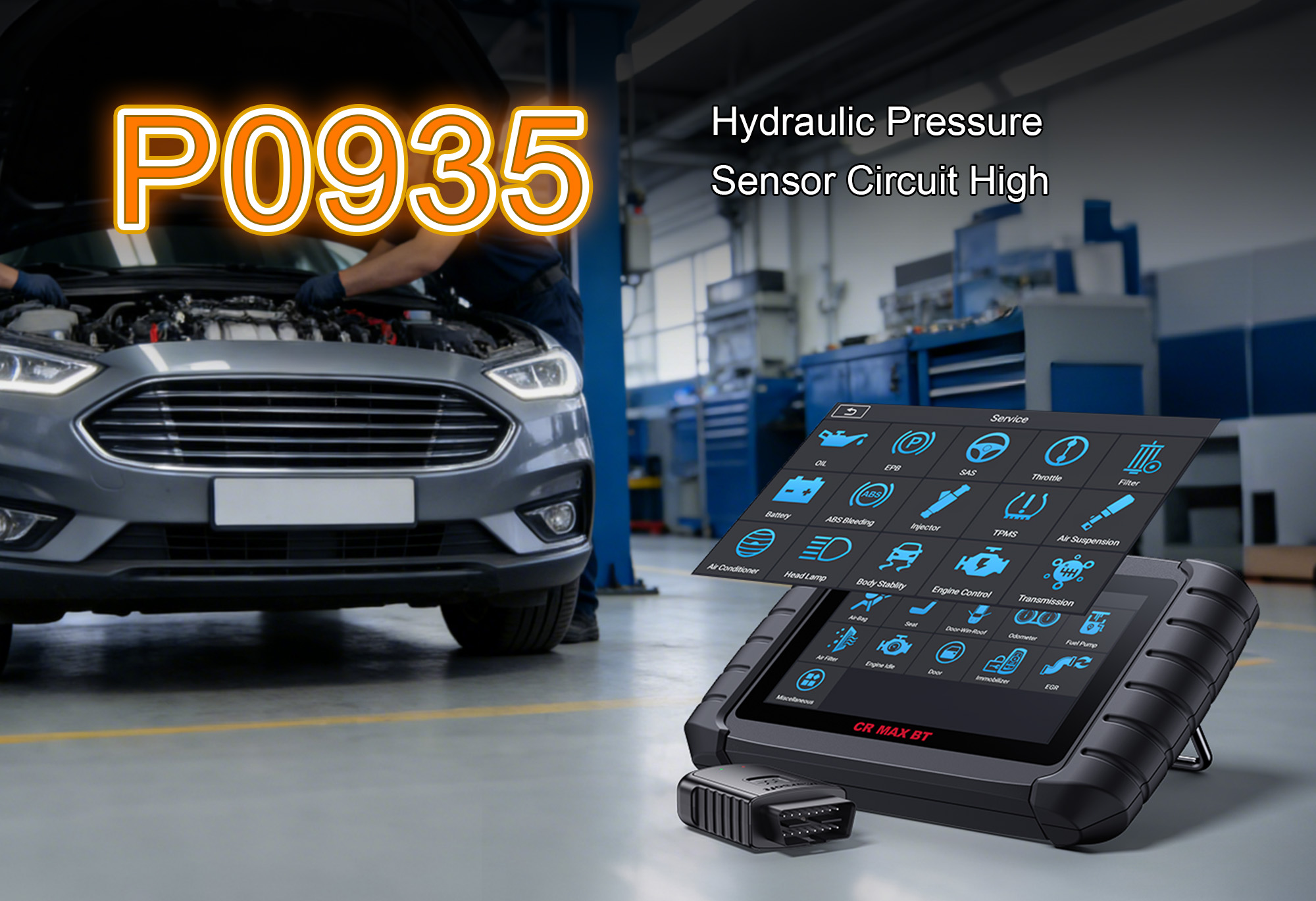
What Is OBD-II Code P0935?
OBD-II Code P0935 is a transmission-specific fault defined as Hydraulic Pressure Sensor Circuit High. The hydraulic pressure sensor (also called a transmission fluid pressure sensor) is mounted on the transmission’s valve body or HCU, responsible for measuring the pressure of transmission fluid as it flows through critical circuits. It converts pressure into an electrical voltage signal (typically 0.5V–4.5V, with higher pressure correlating to higher voltage) and sends this data to the TCM.
The TCM uses this real-time pressure data to make split-second adjustments: calibrating solenoid activation, timing gear shifts, and ensuring smooth torque converter engagement. P0935 triggers when the TCM detects the sensor’s voltage exceeds the factory-specified threshold (usually above 4.5V) for a sustained period. This high-voltage fault indicates a short circuit to power, faulty sensor, or damaged wiring—not a mechanical failure of the transmission core. Unlike low-circuit faults (which signal an open circuit), P0935 means the TCM is receiving an invalid, overstated pressure reading, forcing it into a protective mode (limp mode) to prevent further damage.
P0935 impacts all 1996+ US, 2000+ EU/Asian OBD-II compliant vehicles with automatic, CVT, or DCT transmissions (Ford, GM, Toyota, Honda, Volkswagen, BMW, Mercedes-Benz, etc.)—cars, trucks, SUVs, and vans of all sizes. Critically, 98% of P0935 cases stem from a faulty hydraulic pressure sensor, shorted wiring, or corroded connector—not a failed TCM or valve body—making repairs fast, affordable, and beginner-friendly with the right diagnostic tool.
Common Symptoms of P0935
P0935’s symptoms are directly tied to the TCM’s misinterpretation of hydraulic pressure data and are most noticeable during gear shifts, acceleration, or high-load driving. The check engine light and transmission warning light are immediate primary alerts, and symptoms will worsen rapidly as the fault persists—often leading to limp mode. Watch for these core red flags, all linked to the Hydraulic Pressure Sensor Circuit High fault:
- Illuminated solid Check Engine Light (MIL) and transmission warning light (red/yellow gear symbol) on the dashboard
- Harsh or jerky gear shifts: Abrupt engagement between gears (the TCM overcompensates for false high-pressure readings)
- Transmission slipping: Momentary revving without speed increase during shifts (TCM restricts pressure incorrectly)
- Delayed gear engagement: 1–3 second hesitation when shifting from Park to Drive/Reverse
- Limp mode activation: Transmission locks into 2nd/3rd gear to prevent internal damage (severe cases)
- Reduced engine power: ECM limits power to lower transmission load and minimize stress
- Burning transmission fluid smell: Overheating fluid from improper pressure regulation and increased friction
- Transmission overheating warning: Dashboard alert for high fluid temperature (model-dependent)
- No pressure-related adjustments: Shifts feel forced or unresponsive (TCM uses default pressure settings to avoid damage)
Top Causes of P0935 (Ranked by Likelihood)
Pinpointing P0935’s root cause requires a diagnostic tool that can monitor live sensor voltage, test circuit continuity, and identify short circuits—a feature generic OBD scanners lack. P0935 is caused by electrical issues that inflate the pressure sensor’s signal, and the causes are ordered from most to least common (the first four account for 98% of all P0935 cases):
- Faulty hydraulic pressure sensor: The #1 cause—internal electrical failure (shorted coil, damaged circuitry) sends a constant high-voltage signal or spikes above the factory threshold.
- Short circuit to power: The sensor’s signal wire shorts to the vehicle’s 12V power supply (e.g., battery positive), forcing voltage above the normal range.
- Corroded/loose electrical connector: Rust, water damage, or bent pins in the sensor’s connector create a cross-circuit between the signal and power wires.
- Frayed or broken wiring harness: Physical damage (from heat, engine movement, road debris, or rodent chewing) exposes the sensor’s signal wire, leading to a short to power.
- Overfilled transmission fluid: Excess fluid increases pressure beyond normal limits, causing the sensor to register abnormally high voltage (secondary cause, paired with fluid leakage).
- Clogged hydraulic passage: Blockages in the transmission’s fluid lines create pressure spikes, leading to high sensor readings (temporary, paired with mechanical symptoms).
- Faulty TCM voltage reference circuit: A minor electrical glitch in the TCM’s 5V reference circuit (rare—usually paired with other sensor circuit codes).
- Minor TCM calibration glitch: Extremely rare—a temporary software fault misinterprets the sensor’s signal (easily fixed with a reset via the iCarsoft CR MAX BT).
Why the iCarsoft CR MAX BT Is the Ultimate Tool for P0935
Generic OBD scanners only do one thing for P0935: read the code. They cannot monitor live sensor voltage, test circuit continuity, or identify short circuits—leaving DIYers guessing and replacing expensive parts unnecessarily (e.g., a $1,500 valve body for a $50 sensor). The iCarsoft CR MAX BT is a professional OE-level wireless diagnostic tool optimized for transmission electrical and hydraulic diagnostics, with exclusive features that make it the only tool you need to fix P0935 for good. Leveraging Bluetooth connectivity, compatibility with 58+ major vehicle makes, and bi-directional control, it pinpoints the root cause in minutes. Here’s why it stands out for P0935 troubleshooting:
Tracks live voltage output (0–5V) from the hydraulic pressure sensor, comparing it to factory thresholds to confirm if the signal is high, erratic, or shorted (the single most critical feature for P0935).
Cross-references sensor voltage with actual transmission fluid pressure data (via TCM live streams), distinguishing between a faulty sensor and genuine pressure spikes (e.g., from overfilled fluid).
Scans the entire sensor circuit (wiring, connector, sensor) for short circuits to power, corrosion, and high resistance—finding hidden electrical issues generic scanners miss.
Automatically retrieves vehicle-specific sensor location, wiring diagrams, and voltage parameters for 58+ major makes (Ford, GM, Toyota, BMW, etc.), eliminating manual lookup and ensuring accuracy.
Manually activates the hydraulic pressure sensor via the TCM to test its response to pressure changes (e.g., shifting gears), verifying if the sensor is faulty or the issue is hydraulic.
Enables cable-free operation—perfect for monitoring live data while testing gear shifts or inspecting wiring (no tangled wires interfering with transmission components).
Works with optional videoscopes to inspect hard-to-reach sensor connectors, wiring, and sensor ports for corrosion, damage, or short circuits without disassembling the transmission.
Guides users through make/model-specific fluid level and quality verification, ruling out overfilled/contaminated fluid as a secondary cause of P0935.
Clears P0935 and accompanying transmission/electrical codes in seconds, with a post-repair test drive to verify sensor signal and transmission performance are restored.
Scans all major vehicle systems (engine, transmission, ABS, airbag, TPMS), supports CAN-FD protocol for modern vehicles, and includes lifetime free software updates—plus 40+ reset functions (oil reset, TPMS programming, DPF regeneration) for comprehensive vehicle care, all accessible via a user-friendly touchscreen with multilingual support.
FAQ: Everything You Need to Know About P0935 & iCarsoft CR MAX BT
P0935 means the hydraulic pressure sensor’s circuit is sending an abnormally high-voltage signal (usually above 4.5V) to the TCM. This prevents the TCM from monitoring transmission fluid pressure accurately, leading to erratic shift performance.
P0935 impacts all 1996+ US, 2000+ EU/Asian OBD-II compliant vehicles with automatic, CVT, or DCT transmissions (cars, trucks, SUVs, vans) from 58+ major manufacturers. Manual transmissions never trigger this code (no hydraulic pressure sensor).
Yes—your vehicle will run, but it will have harsh shifts, slipping, or limp mode activation. Driving is possible but risky, as prolonged operation risks severe transmission damage.
You can drive short distances at low speed to get home or to a parts store, but avoid highways, towing, or heavy acceleration. Limp mode limits speed and maneuverability, creating safety hazards.
Replacing the hydraulic pressure sensor (cost: $40–$80) is the #1 fix for P0935. The second most common fix is repairing a shorted wire (cost: $5–$15)—both simple DIY repairs.
No—generic scanners only read the P0935 code and cannot monitor sensor voltage, test circuit continuity, or identify short circuits. The iCarsoft CR MAX BT is required to pinpoint the exact cause.
Only if P0935 is caused by overfilled or contaminated fluid (secondary cause). If the fault is electrical (failed sensor, shorted wiring), changing fluid will not resolve the root issue.
No—once you’ve repaired the root cause (e.g., replaced the sensor, fixed wiring, drained excess fluid), the iCarsoft CR MAX BT lets you clear P0935 with one click and reset the TCM’s pressure calibration—no mechanic or dealer visit required. Its wireless design and multilingual support add further convenience.
Final Thoughts: Don’t Let P0935 Destroy Your Transmission
OBD-II Code P0935—Hydraulic Pressure Sensor Circuit High—is a critical but fixable transmission fault that compromises shift quality and risks long-term damage. Generic scanners leave you stuck in trial-and-error, leading to expensive mistakes like valve body replacements for a cheap sensor, and dealers often upsell unnecessary overhauls. But P0935 doesn’t have to be a costly repair: the iCarsoft CR MAX BT is designed specifically for transmission diagnostics, with exclusive voltage monitoring, short circuit detection, and hydraulic pressure verification that unlock the exact root cause (sensor, wiring, fluid) in minutes.
The hydraulic pressure sensor is the "eyes" of your transmission’s pressure system—its reliable signal ensures the TCM can make precise adjustments for smooth, durable shifts. An electrical fault in this sensor turns every gear change into a source of wear, burning fluid and damaging clutches. P0935 is not just a check engine light: it’s your vehicle’s way of warning you of a small, easy-to-fix issue—before it becomes a $2,000+ transmission repair. The iCarsoft CR MAX BT isn’t just a tool for fixing P0935: it’s a full OE-level wireless diagnostic scanner that supports 58+ major makes, offers lifetime free software updates, and comes with 40+ reset functions—making it an essential tool for every owner of an automatic/CVT/DCT vehicle.
Ready to fix P0935, restore smooth gear shifts, and protect your transmission from catastrophic failure? Grab the iCarsoft CR MAX BT today—no mechanic required!
Disclaimer: This guide is for informational purposes only. Always consult your vehicle’s service manual or a certified automotive technician before repairing or replacing hydraulic pressure sensors, wiring harnesses, or transmission fluid components. iCarsoft is not responsible for damage from improper tool use or vehicle maintenance.